This year marks Inclusioneering’s 5th birthday – a moment to pause, reflect, and look honestly at what the last five years have taught us about inclusion, change, and the work still ahead.
Inclusioneering was born as Jo Stansfield was finishing her Master’s in Organisational Psychology, with a strong focus on diversity, equity, and inclusion in the workplace.
Like many founders, she reached a pivotal moment – how do Jo turn what she had learned into something that will make a difference?
Where Inclusioneering began:
The purpose was simple, but ambitious – to put theory into practice, highlight common workplace challenges around inclusion, and start trying to shift them.
It was about making an impact, not just observations, and using what we’ve learned to help organisations change how people experience work.
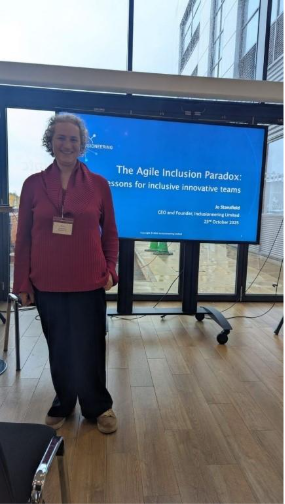
Jo leading an Agile Inclusion Paradox workshop
How Inclusioneering has evolved:
From the beginning, Inclusioneering focused on engineering, manufacturing, and technology – sectors that shape our world but have often struggled with inclusion. That focus hasn’t changed, and deliberately so.
What has changed is depth.
Over time, working closely with organisations has brought more colour, richness, and nuance to the work.
Inclusioneering now often finds itself embedded in funded projects where universities and industry collaborate to innovate something entirely new – not just in technology, but in how people work together and in considering the social impacts of the work.
There’s real joy in this work. In seeing the future being actively shaped, and in witnessing how thoughtful inclusion can unlock better ideas, better systems, and better outcomes. As Jo puts it, ‘It’s inspiring to be part of what people are building and to help ask, how could this be even better’?
‘This is why we do this’ moments
Every organisation working in DEI has moments that reaffirm why it matters.
For Inclusioneering, one of those moments has come through COIL workshops, where students collaborate with peers in different countries. The feedback has been powerful with students speaking about how much they loved the experience, how it changed their perspectives, and how meaningful it felt to work across cultures.
Another defining moment has been working with the foundation industries. These are the industries that create our foundational materials: metals, glass, cement, ceramics, chemicals, and paper, where DEI was a completely new conversation. These were first-time projects, first steps, and big questions – where do we even start and how do we build a community around this?
Being trusted to help shape those beginnings has been both humbling and motivating.
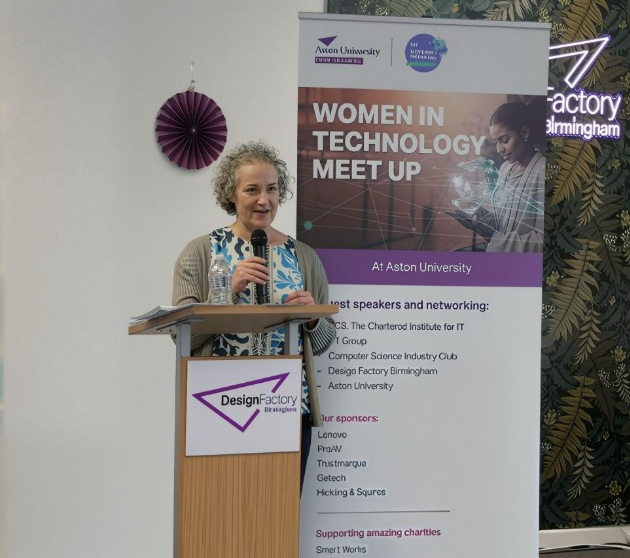
Jo speaking at a Women in Technology Meet Up at Aston University
The power of collaboration and community
Inclusioneering’s journey hasn’t been a solo one, far from it. Every piece of work has been shaped by clients, universities, businesses, associates, and collaborators. When you work independently, that network becomes crucial. It’s a source of support, challenge, insight, and shared learning.
What still needs to change
Inclusion work doesn’t have a finish line, and that can feel daunting.
The world keeps pivoting. Politics shift. Attitudes evolve. New challenges emerge. By its very nature, inclusion must be continuous, because society itself is never static.
What the last five years have made clear is just how many levels need to change for society to truly change. It’s not enough to focus on one area and hope the rest will follow.
Workplaces matter – how teams collaborate, how policies are written, how procedures are applied. But so do patterns of behaviour, social norms, and early exposure to opportunities. Through volunteering and outreach, Jo has seen the importance of introducing people to new ideas and possibilities.
Thinking systematically, acting individually
Inclusioneering’s work with organisations like TransFire and the Royal Academy of Engineering has reinforced a crucial lesson – systemic change requires action at every level.
Policies shape lives. Systems influence opportunities. But it also comes down to individuals ensuring that no one is facing discrimination, that the ‘right thing’ becomes the natural thing to do.
You can’t expect one level to change and fix everything else. Progress happens when workplaces, systems and people move together.
Looking ahead
Five years in, Inclusioneering knows more than it did at the start, especially about how complex meaningful change really is. But that hasn’t dampened the mission. If anything, it sharpened it.
Because inclusion isn’t a trend. It’s not a tick-box exercise. It’s ongoing, evolving work, and work worth doing. Here’s to the next 5 years.
